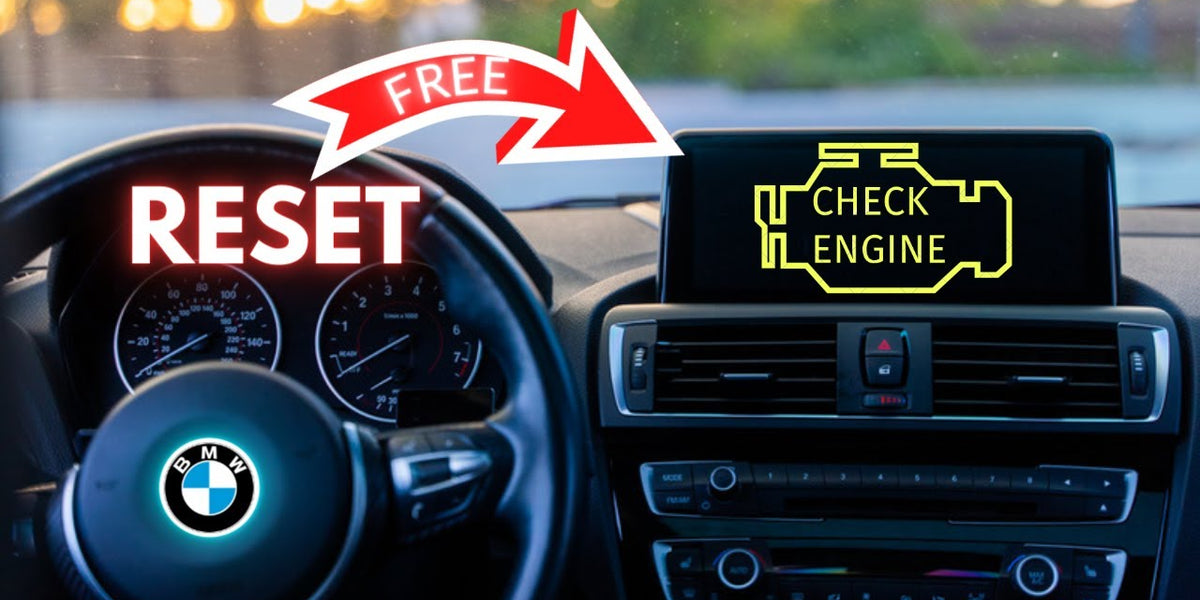
Your car runs rough, the check engine light refuses to turn off after a repair, or the throttle feels sluggish. These symptoms often mean your Engine Control Unit is holding onto outdated data. While dealerships and mechanics use expensive OBD2 scanners to reset it, you can accomplish the same result using simple methods that cost nothing. This guide covers six proven techniques to reset the ECU without a scanner, including step-by-step instructions and important safety precautions.
Learning how to reset ECU without a scanner gives you a powerful troubleshooting tool. Whether you have an older Toyota, Honda, Ford, or a pre-2005 vehicle, these methods clear stored trouble codes, reset fuel trims, and force the system to relearn optimal settings.
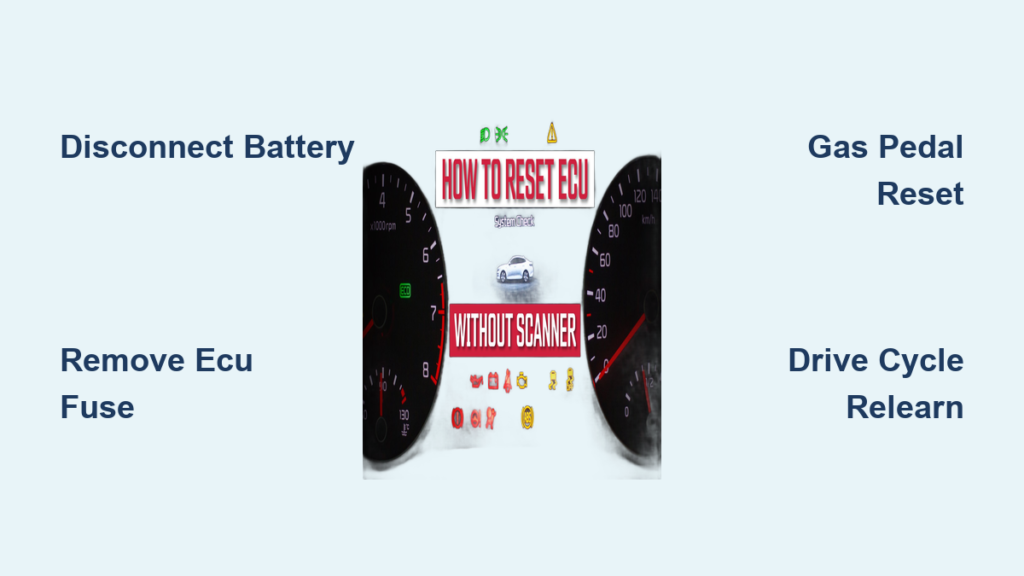
Disconnect Battery Negative Terminal

This method is the most reliable and widely compatible approach for resetting the ECU without specialized tools.
Why It Works
Removing the negative battery cable cuts power to the ECU and drains residual voltage from capacitors. This clears adaptive memory, fuel trims, idle settings, and stored diagnostic trouble codes.
Step-by-Step Reset
- Turn off the engine and engage the parking brake.
- Locate the battery, which is usually under the hood.
- Use a 10mm wrench to loosen the nut on the black negative terminal.
- Remove the cable and tuck it away from the battery post to prevent accidental contact.
- Wait 15 to 30 minutes to ensure full capacitor discharge.
* For older vehicles or stubborn codes, wait up to 60 minutes. - Reconnect the negative terminal and tighten securely.
- Start the engine and let it idle for 5 to 10 minutes with no accessories turned on.
What to Expect
The check engine light may turn off if no active faults remain. Radio presets, clock, and seat memory will likely reset. Some vehicles require a security code for the radio after this procedure.
Pro Tip: Turn on the headlights for 2 to 3 minutes before disconnecting to speed up capacitor discharge.
Perform Battery Ground Short Reset
This enhanced method forces a complete discharge of all electronic modules, including the ECU, body control module, and transmission control module.
When to Use This Method
Consider this approach when dealing with immobilizer or anti-theft system activation, multiple warning lights appearing simultaneously, or radio and HVAC systems behaving erratically.
How to Force a Full Discharge
- Disconnect both battery terminals, starting with negative then positive.
- Use a jumper wire with alligator clips. Attach one end to the negative cable, wrap the other end in a rag, and briefly touch it to the positive battery post to create a ground path.
- Wait 30 to 60 minutes to drain all control modules.
- Remove the jumper wire, then reconnect the battery, starting with negative then positive.
- Start the engine and let it idle for 5 minutes or longer.
Safety First
Never reconnect the battery while the jumper wire is still attached. Work in a well-ventilated area because batteries emit flammable hydrogen gas. Wear insulated gloves to prevent shocks.
Remove ECU Fuse for Quick Reset
This fast method resets the ECU without affecting radio presets, clock settings, or other convenience features.
Locate the Correct Fuse
- Open the fuse box, which is usually located under the hood or beneath the dashboard.
- Check the lid diagram for labels like ECU, ECM, PCM, or Engine Main Relay.
- Identify the amperage, which is typically 10A to 20A.
Reset Procedure
- Use a fuse puller or tweezers to remove the ECU fuse.
- Wait 1 to 5 minutes to interrupt power long enough to reset memory.
- Reinsert the fuse firmly into place.
- Start the engine, and the ECU begins relearning immediately.
Pros and Cons
- Keeps radio presets and clock settings intact
- Safer for drive-by-wire throttle systems
- May not clear all DTCs on modern vehicles with advanced memory
Best for: Toyota Corolla, Honda Civic, and other mid-2000s models after MAF or O2 sensor replacement.
Use Gas Pedal Reset for Throttle Relearn

This manufacturer-specific method resets throttle position and idle settings on certain Toyota and Honda models.
Toyota Throttle Relearn Procedure
- Sit in the driver seat with the key removed or in your pocket.
- Press the start button twice without pressing the brake to power the dashboard on.
- Within 3 seconds, press and release the gas pedal 5 times in 5 seconds.
- Wait 7 seconds, then hold the pedal down for 10 seconds.
- Watch for the check engine light to blink slowly.
- Release, then press and hold again for 10 seconds.
- The light stops blinking and flashes rapidly to indicate reset complete.
- Turn the vehicle off, wait 10 seconds, then restart.
Works On
This method works on Toyota Camry, Corolla, RAV4, and 4Runner. It also applies to Honda Accord, CR-V, and Civic models, plus certain Nissan vehicles.
Warning: This does not work on all models. Consult your owner manual for the exact sequence for your specific vehicle.
Try Key Cycling for Older Vehicles
This simple ignition-based reset works on pre-2000 models with mechanical throttle systems.
How to Do It
- Turn the key to ON without starting the engine.
- Wait 3 to 5 seconds.
- Turn the key back to OFF.
- Repeat the cycle 5 to 10 times.
- Wait 1 to 2 minutes, then start the engine.
Best For
This method works best on pre-OBD2 vehicles, models with mechanical throttle systems, and for resetting maintenance reminder lights.
Limitation: This approach is often ineffective on modern drive-by-wire ECUs found in vehicles manufactured after 2000.
Press Climate or Radio Buttons for OEM-Specific Reset
Some manufacturers allow resets through specific button combinations built into the vehicle.
General Procedure
- Turn the ignition to ON with the engine off.
- Hold the Auto and Defrost buttons on the climate control panel for 10 or more seconds.
- Watch for a dashboard chime or flashing light that indicates a reset is in progress.
Vehicle Examples
Honda models use the Trip and Reset buttons. BMW vehicles use the iDrive menu to reset service intervals. Toyota models may use Menu and Scan buttons for maintenance resets.
Important: These button sequences often reset BCM or maintenance lights rather than full ECU codes. Always verify the correct procedure in your owner manual.
Know Which Vehicles to Avoid Manual Reset
Not all vehicles can be safely reset without a scanner. Some modern systems require dealer-level recalibration.
Safe to Reset Manually
These vehicles respond well to manual reset methods. Pre-2005 models with mechanical throttle, standard automatic or manual transmissions, and older Toyota, Honda, Ford, and Chevrolet vehicles.
Avoid Manual Reset On
These systems can experience serious issues after manual resets. Drive-by-wire throttle systems in 2010 and newer vehicles, start-stop engines, hybrids and electric vehicles, and luxury brands like BMW, Mercedes, Audi, and Porsche all require professional diagnostic tools.
Real Risk: A 2017 Toyota Highlander entered limp mode after a simple battery disconnect and required a dealer scan tool to recalibrate the electronic throttle.
Follow Post-Reset Relearning Steps
After any reset, the ECU must relearn engine behavior through a specific drive cycle.
Drive Cycle for Full Relearn
- Warm up the engine by idling 2 to 5 minutes until coolant temperature exceeds 160°F.
- Drive in city traffic for 15 minutes at 20 to 30 mph with gentle acceleration and stops.
- Drive on the highway for 20 minutes at 55 to 65 mph.
- Coast down from speed without using brakes to complete deceleration.
- Park and let the engine idle for 1 to 2 minutes.
Relearning Timeline
Short-term fuel trims and idle settings reset within minutes. The ECU requires 10 to 20 drive cycles for smooth operation. Full adaptation, including long-term fuel trims and transmission shift points, may take up to 100 miles.
Emissions Note: After reset, readiness monitors clear. It can take 50 to 100 miles of mixed driving to pass state emissions inspections.
Recognize When to See a Mechanic
A reset is not a fix for hardware problems. Some situations require professional diagnosis and equipment.
Signs You Need Professional Help
Seek assistance if the check engine light returns after reset, if rough idle, misfires, or stalling persist, if the transmission enters limp mode, or if you notice unusual noises, smoke, or power loss.
What a Mechanic Can Do
Professionals can run a full OBD2 scan to find active faults, test sensors and wiring, perform ECU reprogramming or software updates, and use OEM tools for calibration on complex systems.
Expert Tip: Use free scan tools at AutoZone, O’Reilly, or Advance Auto Parts to read codes before attempting any reset.
Compare ECU Reset Methods
| Method | Time | Tools Needed | Resets Radio | Best For |
|---|---|---|---|---|
| Battery Disconnect | 15-60 min | Wrench | Yes | General reset, stubborn codes |
| ECU Fuse Removal | 1-5 min | Fuse puller | No | Quick reset, preserve settings |
| Battery Ground Short | 30-120 min | Jumper wire | Yes | Security lockouts, BCM issues |
| Gas Pedal Reset | 2 min | None | No | Throttle relearn (Toyota/Honda) |
| Key Cycling | 5 min | None | No | Older models, maintenance |
| Button Sequence | 1 min | None | No | Brand-specific recalibration |
Frequently Asked Questions About ECU Reset Without Scanner
Can I reset the ECU by just disconnecting the battery?
Yes, disconnecting the negative battery terminal for 15 to 30 minutes is the most common scanner-free method. This clears adaptive memory and stored trouble codes. However, the ECU will need to relearn your driving patterns over several drive cycles.
Will resetting the ECU turn off the check engine light?
The check engine light should turn off after a proper reset if there are no active faults remaining. If the light returns, there is likely an underlying mechanical issue that the ECU is detecting.
How long does it take for the ECU to relearn after a reset?
Basic idle and fuel trims relearn within minutes. Full adaptation, including transmission shift points and long-term fuel trims, takes 10 to 100 miles of driving depending on the vehicle and how it is driven.
Does resetting the ECU delete my radio presets?
Yes, disconnecting the battery will reset radio presets, clock, seat memory, and other convenience settings. Using the ECU fuse removal method preserves these settings.
Can I reset the ECU on a newer car with drive-by-wire?
It is not recommended. Modern vehicles with electronic throttle control may enter limp mode or experience drivability issues after a manual reset. These systems often require dealer-level recalibration with OEM tools.
What happens if I reset the ECU but the problem returns?
If problems recur after a reset, the issue is likely mechanical rather than electronic. Common causes include vacuum leaks, failing sensors, clogged injectors, or wiring damage that requires professional diagnosis.
Key Takeaways for Resetting ECU Without Scanner
Manual ECU resets work effectively on older vehicles and those with mechanical throttle systems. The battery disconnect method remains the gold standard for its reliability and compatibility across most makes and models. Always wait the full discharge time and perform a complete drive cycle after resetting to ensure proper relearning. Document any trouble codes before resetting, and seek professional help if problems persist or return after the procedure.
Remember that a reset clears data, not hardware. Fix the underlying mechanical issue first, then use these methods to restore optimal ECU performance.