Every time you step into an airport security line, you’re interacting with some of the most advanced detection technology in the world. Whether walking through a full-body scanner or placing your bag on the conveyor belt, you’re part of a highly engineered system designed to stop threats before they reach the aircraft. But how does airport scanner work? Behind the seamless process lies a blend of physics, computing, and real-time threat analysis that keeps air travel safe.
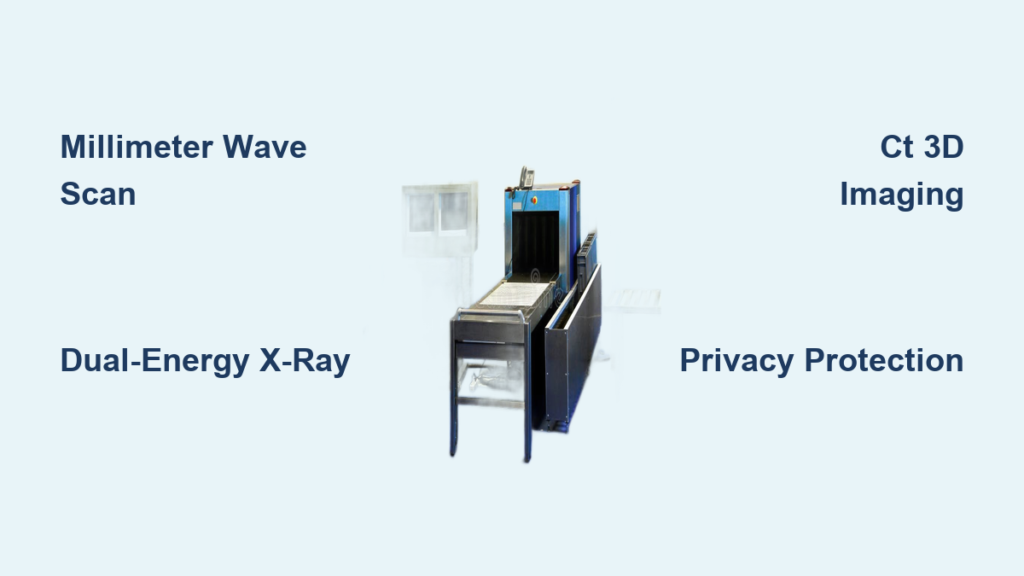
Modern airport scanners use two main approaches: passenger body scanning and luggage X-ray imaging. The former detects hidden items under clothing using non-ionizing radio waves or legacy X-ray technology, while the latter employs dual-energy and CT X-rays to peer inside bags. These systems are regulated, safe, and constantly evolving, balancing security, speed, and privacy.
In this guide, you’ll learn exactly how each scanner functions, what they can and cannot detect, their safety profiles, and what happens behind the scenes when your bag disappears into the tunnel.
Millimeter Wave Body Scanners
Millimeter wave scanners are now the standard for passenger screening at most major airports. They use non-ionizing electromagnetic radiation in the 30 to 300 GHz frequency range, which is too weak to damage DNA or cells. These signals are thousands of times weaker than a cell phone’s output, making them safe for all travelers, including children and pregnant individuals.
How the Scan Works
Inside the scanner, rotating antenna arrays emit low-power millimeter waves from top to bottom. As the waves bounce back, sensors capture the timing and strength of each reflection. A computer then constructs a 3D silhouette of the body’s surface.
Modern systems run Automated Target Recognition software, which replaces anatomical details with a generic, gender-neutral outline. If something unusual is detected, the system highlights it with a yellow box on the avatar. Operators never see your actual body. They view only the simplified image from a remote location, and all data is deleted immediately after review.
What Triggers an Alarm
The scanner flags anomalies based on shape, density, and dielectric properties. Common detections include plastic or ceramic knives, explosive materials, guns hidden under jackets, and bundles of cash or drugs. However, false alarms can occur due to clothing folds, medical dressings, or loose fabric bunching. If a yellow box appears, you’ll be directed to a secondary screening, typically a pat-down.
Metal Detectors: Basic but Still Used
Metal detectors remain a staple at checkpoints worldwide. They generate a magnetic field via coils in the scanner frame. When metal passes through, it disrupts the field and triggers an audible alarm.
These systems are excellent for finding ferrous and non-ferrous metals like knives, guns, or belt buckles. However, they cannot detect non-metallic threats such as plastic explosives or ceramic weapons. Because they rely solely on conductivity, metal detectors often miss modern threats.
Travelers with medical devices like pacemakers, joint replacements, or insulin pumps may trigger false alarms. In these cases, you can choose a manual pat-down instead. This option is available to anyone, and no explanation is needed. Despite limitations, metal detectors serve as a first-line filter, often used alongside millimeter wave scanners for layered security.
Luggage X-Ray Scanners: Dual-Energy Imaging

Your carry-on bag passes through a cabinet X-ray system that uses dual-energy imaging. This means the machine emits two types of X-rays, high and low energy, to distinguish materials by atomic composition.
As X-rays pass through your bag, different items absorb them at varying rates. Organic materials like plastics, food, and explosives absorb more low-energy rays. Inorganic materials like metals and ceramics absorb more high-energy rays. Software compares the two absorption patterns to estimate the effective atomic number and density of each object.
Color-Coded Threat Display
Security officers view a real-time, color-coded image. Orange represents organic compounds, which could mean explosives, drugs, or food. Blue or green indicates inorganic materials like metals, tools, or batteries. Black shows very dense items like lead shielding or thick steel. These colors are artificially assigned to help screeners spot suspicious combinations.
Dual-energy X-rays reliably identify firearms and disassembled weapon parts, knife blades, improvised explosive devices, narcotics in plastic bags, and lithium-ion batteries. However, overlapping items or tightly packed bags can obscure threats, leading to manual inspection.
CT Scanners for Luggage: 3D Imaging
Computed tomography scanners, adapted from medical imaging, are revolutionizing baggage screening. Instead of a single 2D image, CT systems take hundreds of X-ray slices as the bag moves through a rotating gantry.
A computer reconstructs these into a 3D volumetric model, allowing screeners to rotate the bag 360 degrees, zoom in on specific areas, slice through layers digitally, and measure material density in Hounsfield units. This level of detail dramatically improves threat detection, especially for overlapping or concealed items.
Automated Threat Recognition
Advanced CT systems use AI-powered algorithms that automatically flag objects matching explosive signatures. For example, if a gel-like substance has the density and shape of a known explosive, the system highlights it for review. This reduces reliance on human judgment and cuts down false alarms.
One major benefit is that electronics can stay in your bag. In older systems, laptops had to be removed because their dense circuitry blocked views of underlying items. CT scanners can see through them using multi-angle reconstruction. TSA has accelerated deployment under the Checked Baggage Inspection System program, and many U.S. airports now use CT for both checked and carry-on bags.
Backscatter X-Ray Scanners: Retired Technology
Backscatter X-ray scanners were once used in U.S. airports but have been fully phased out. They relied on low-energy ionizing X-rays that bounced off the skin, producing high-contrast surface images.
Each scan delivered about 0.1 microsieverts of radiation, equivalent to 2 to 3 minutes of flying at cruising altitude. While the dose was negligible, public concern over cumulative exposure and privacy grew. The biggest issue was privacy. Early versions produced anatomically detailed images that critics called an electronic strip search.
By 2013, the TSA replaced all backscatter units with millimeter wave scanners equipped with ATR software, which show no personal details. As of 2026, backscatter scanners are no longer in use for passenger screening in the United States.
Radiation Safety: What You Need to Know
Understanding radiation types helps clarify safety concerns. Millimeter wave scanners use non-ionizing radio waves and pose no known health risk. Their energy output is far below international safety limits set by ICNIRP and IEEE. Even frequent flyers receive more radiation during flight than from a body scan.
Luggage scanners use higher-energy X-rays, but the machines are fully shielded with lead. Interlock switches cut power if opened, and radiation warning lights indicate operation. There is zero measurable exposure outside the unit. Regulatory bodies like the FDA, CDC, and DHS enforce strict safety standards, and all equipment undergoes routine testing for leakage and performance.
Privacy Protections in Modern Scanners
One of the biggest concerns with early scanners was image retention. Today, that’s no longer an issue. All millimeter wave scanners with ATR software generate only a generic human outline, display threat locations as yellow boxes, automatically delete images after review, and prevent storage, transmission, or retrieval.
Operators view results from remote rooms, with no audio or visual link to the passenger. No one sees your body, and no image is saved. This system has resolved most privacy controversies, making modern scanning both effective and respectful.
What Scanners Cannot Detect

Even advanced scanners have limits. Items inside body cavities, such as swallowed pills or internal concealment, are invisible to millimeter wave and backscatter systems. Trace chemical residues like gunpowder or explosive dust require swab testing with ion mobility spectrometry.
Very thin, flat objects that conform tightly to the body, like a sheet of plastic explosive, may go undetected unless they create a detectable reflection pattern. Shielding with conductive materials like aluminum foil can block millimeter wave signals, but this often raises suspicion during analysis.
Traveler Rights and Options
You have the legal right to refuse a body scan and request a manual pat-down instead. This applies to all passengers, regardless of age, gender, or medical condition. The pat-down is conducted by a same-gender officer and follows standardized procedures. It includes hands-only contact, no removal of clothing, and documentation if requested.
Opting out does not delay you permanently, though secondary screening may add a few minutes. Pregnant travelers should know all scanners are FDA-approved as safe. Children are fully cleared for scanning, and parents may choose a pat-down. If you have concerns about medical implants, inform the officer before screening begins.
Real-World Effectiveness and Stats
Airport scanners are not just theoretical. They work. In 2023 alone, TSA agents found over 6,000 firearms in carry-on bags at U.S. airports. CT scanners have reduced false alarm rates by up to 50 percent, cutting down unnecessary bag checks and improving passenger flow.
AI-driven ATR systems are getting better at detecting homemade explosives, powdered narcotics, and liquid threats hidden in toiletries. Ongoing research focuses on photon-counting detectors for higher resolution, multi-spectral imaging to identify materials faster, and real-time AI analysis to reduce human error.
Key Takeaways for Understanding Airport Scanners
.png?v=1775475695)
Airport scanners combine scientific precision with operational efficiency to protect millions of travelers daily. Millimeter wave scanners use harmless radio waves to detect both metal and non-metal threats. Luggage scanners use dual-energy and CT X-rays to create color-coded or 3D images of bag contents. No images are stored, and privacy is protected through automated software and remote viewing. Radiation exposure is negligible or zero, and you actually get more radiation during a flight than from any scanner. You can always opt out and choose a pat-down instead.
These systems do not rely on luck. They are data-driven, regulated, and continuously upgraded tools that make air travel one of the safest modes of transportation. So next time you raise your arms in the scanner, know that you’re part of a sophisticated, science-backed process designed not to invade your privacy, but to keep the skies safe for everyone.
Frequently Asked Questions About Airport Scanners
Do millimeter wave scanners use harmful radiation?
Millimeter wave scanners use non-ionizing radio waves, not harmful X-rays. The energy output is thousands of times weaker than a typical cell phone transmission and poses no known health risk to passengers.
Are airport scanners safe for pregnant women and children?
Yes. All scanner types used for passenger screening are considered safe by the FDA, TSA, and international health agencies. Millimeter wave scanners emit no ionizing radiation, and luggage X-rays are fully shielded.
Can scanners detect items inside body cavities?
No. Millimeter wave and backscatter scanners only reflect off the skin surface. Items hidden inside body cavities require other detection methods like swab testing or physical searches.
Can I refuse a body scan?
Yes. You may legally refuse any body scan and request a manual pat-down instead. This option is available to all passengers, and no explanation is required.
Do scanners store or share images?
No. Modern millimeter wave scanners with ATR software automatically delete all images immediately after review. No images are stored, transmitted, or shared with any third party.
How long does a body scan take?
The actual scan takes less than 10 seconds from the moment you enter the portal until the result is displayed. The entire process, including preparation and result review, typically takes under one minute.